
Law enforcement has always been a critical partner in the fight against human trafficking. For almost two decades, Polaris has collaborated closely with survivors, officers, investigators, and task forces at every level — responding to Hotline signals, analyzing trends, and co-creating solutions that improve outcomes for survivors and increase the likelihood of trafficker accountability.
Much of what we know about what makes a tip actionable was shaped through these partnerships. We’ve led joint trainings, hosted working sessions with local, state, and federal agencies, and consulted directly with law enforcement on how to strengthen coordination and response. For example, in June 2024, the Polaris-trained Hotline Case Response and Partnerships teams trained the Homeland Security Investigations’ Victim Assistance Program about how to utilize the Hotline to support their work, what to expect when contacting the Hotline as a law enforcement partner, and how to request assistance with flights or hotels for potential victims.
Our CEO has even provided training at law enforcement conferences to help bridge the gap between frontline realities and trauma-informed best practices.
At the National Human Trafficking Hotline, every signal is important. But not every signal becomes a case. That’s why the quality of information we receive can shape outcomes for both survivors and law enforcement.
The Numbers Behind the Work
Since its launch, the Hotline has received 463,109 signals, ranging from calls and texts to emails and webform entries — leading to 112,822 distinct trafficking cases and identifying 218,568 victims. Since 2020, the Hotline has reported nearly 14,000 situations of potential trafficking to our law enforcement partners.
Last year alone, the Hotline received 32,309 signals, identifying 11,999 trafficking situations involving 21,865 victims.
The numbers tell us two things:
- Volume is high, but only a portion of signals are truly actionable.
- Clarity, specificity, and survivor consent are key to turning a tip into meaningful action.
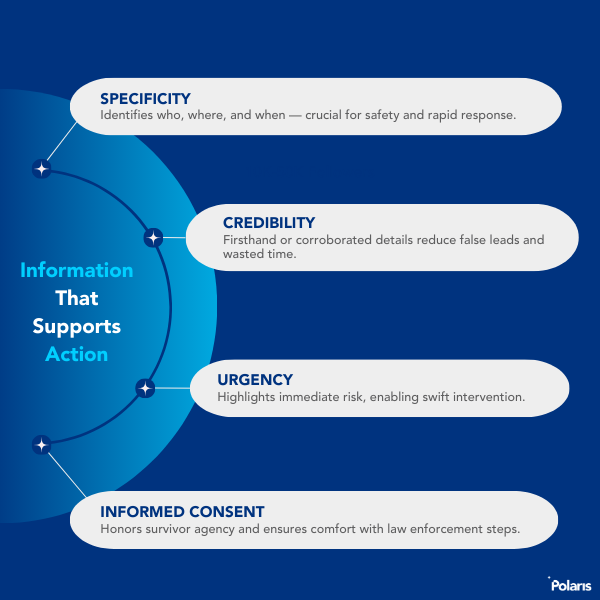
What Makes a Tip “Actionable”? Insights from the Field
These aren’t rigid requirements, but they reflect the kinds of information that officers consistently tell us are most useful when time is short and lives are at risk. They also help ensure that survivors are supported in a way that builds trust and safety.*
Sign up to learn more about human trafficking and how you can help
Why Trauma-Informed Leadership Matters
For Survivors
Automatically routing every tip to law enforcement — regardless of context — can have unintended consequences. Some survivors fear that doing so could escalate their situation, lead to retaliation, or involve systems that they don’t trust.
A trauma-informed approach helps ensure that law enforcement is engaged when it’s most effective: when survivors are ready, and when the risk is clear and actionable.
This kind of intentional coordination builds trust, protects survivors, and helps law enforcement and social services partners focus resources where they’re needed most. A trauma-informed approach offers choices, not ultimatums to victims and survivors.
For Law Enforcement
Without filters, officers receive fragmented or non-urgent tips that strain resources and slow down response.
Prioritizing actionable tips leads to more efficient investigations and stronger outcomes.
When law enforcement can focus on credible, time-sensitive cases, their efforts are more likely to result in meaningful interventions and survivor safety.
For the Social Services Partners & Anti-Trafficking Organizations
When survivor-led groups, advocates, service providers, and law enforcement align around shared values and data, we are stronger. Trust builds. Outcomes improve. Together, we move toward responses that reflect real needs. We become more responsive, not just reactive. Coordinated, trauma-informed responses ensure that no partner is working in isolation — and that survivors receive the right support at the right time.
Moving Forward, Together
This isn’t all just theory. It’s the result of years of working side by side to improve outcomes for survivors and build stronger cases against traffickers.
Trauma-informed leadership starts with questions:
- How can we co-create and share clear factors for actionable tips — so law enforcement can act and hold traffickers accountable swiftly?
- What non-law enforcement pathways support survivor safety, autonomy, and long-term stability?
- How can leaders embed trauma-informed values into every training, protocol, and partnership — ensuring justice and healing go hand in hand?
Because when we equip law enforcement with the right information — not just more of it — we honor survivor agency, sharpen our collective focus, and increase the chances of holding traffickers accountable. Together, we can make our anti-trafficking response smarter, healthier, and more effective for everyone involved. make our anti-trafficking response smarter, healthier, and more effective for everyone involved.
*All communications with the Hotline are confidential, including contact information, unless the person reaching out: gives permission to share contact information, expresses threat to harm themselves or others, discloses information regarding the abuse, neglect, or trafficking of a minor, or reports a life-threatening emergency or imminent harm.
If you or someone you know are experiencing human trafficking, please reach out to the National Human Trafficking Hotline for support.
Stop human trafficking today
Help fix the broken systems that make trafficking possible so we can prevent it from happening in the first place.